
Patrick LeBeau
- (He/Him)
- lebeau@msu.edu
- 234 Ernst Bessey Hall
- Professor
- Writing, Rhetoric, and Cultures
Biography
I am Lakota from my father’s side of the family, and that my “Tiospaye” is “Mnikoju,” or “Planters By The Water”, of the Lakota or “Titunwan,” “the People of the Plains,” but I am also Chippewa (or plains Ojibwe, or Anishinaabe) from my mother’s side. My father, Herbert LeBeau, was a member of Cheyenne River Sioux Tribe of South Dakota, which is an American and legal definition. My mother, Leona Wilkie LeBeau, was a member of Turtle Mountain Chippewa Tribe of North Dakota. By law I can only be a legal member of one of these tribes and considered an ancestral descendant of the other. As you can ascertain, I am Chippewa, Lakota, and a little bit French.
Works
Books:
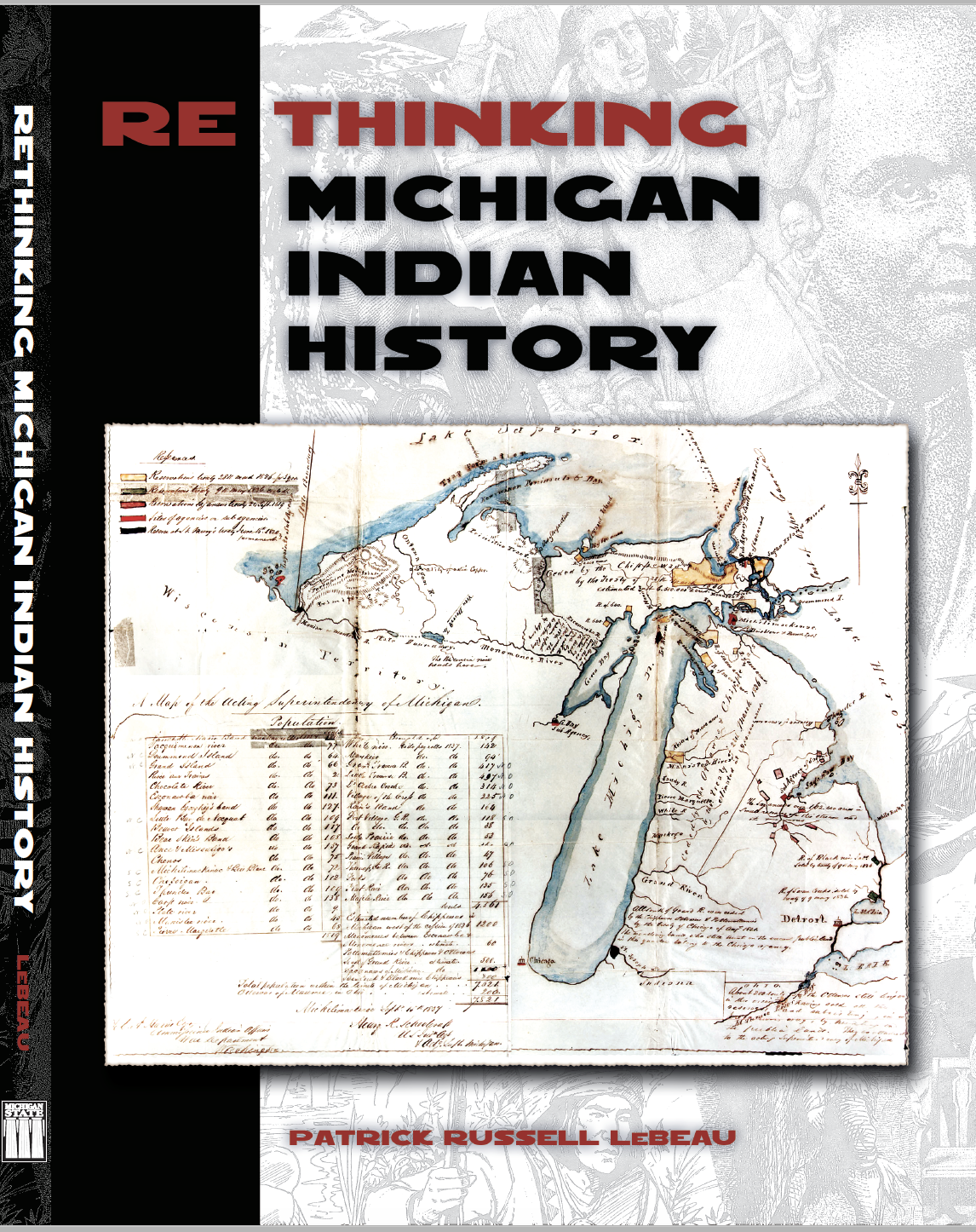
Rethinking Michigan Indian History. East Lansing, MI: Michigan State University Press 2005. A text designed for students and teachers, 4th grade to college level, to rethink Michigan Indian history and to examine, and challenge, what they already know about Indians.
Stands Alone, Faces, and Other Poems. East Lansing, MI: Michigan State University Press, 1999. A collection of poems and one short story.
Term Paper Resource Guide to American Indian History. Westport, CT: Greenwood Press, 2009. Provides students and libraries with a resource that identifies and explicates the most pertinent historical events relating to American Indians in a general and accessible format.
Peer-Reviewed Book Chapters and/or Poems:
“Center Pole (Hanbleceya),” The Gift. Martin, South Dakota: Center for American Indian Research and Native Studies, 2021. 29.
“Assignation with Sitting Bull,” South Dakota in Poems,” ed. Christine Stewart-Nuñez. South Dakota State Poetry Society, 2020.
“No bullets No sticks No stones, Only Words to Hurt me We (Article the First),” a Poem. Articles of a Treaty: 1868 Poetry Chapbook. Center for American Indian Research and Native Studies, 2019.
“Article I.” Articles of a Treaty: An Educational Art Exhibit About the 1868 Fort Laramie Treaty. Center for American Indian Research and Native Studies, 2019.
“Assignation with Sitting Bull,” a Poem. Takuwe: An Educational Art Exhibit About the Wounded Knee Massacre. Center for American Indian Research and Native Studies, 2018.
“Relative Placement,” a Poem. Tapun Sa Win: An Educational Exhibit Based on a Lakota Narrative. Center for American Indian Research and Native Studies, 2017.
“A Race is a Race is a Race,” a Poem. The Great Race. Center for American Indian Research and Native Studies. 2016.
“Origin-of-Poem Story: Origin and Ownership of an Indian Poem, ‘Earth Death,’” Stories Through Theories/Theories Through Stories. Eds. Gordon Henry, Nieves Pascual Soler and Silvia Martinez-Falquina. Michigan State University Press, 2009. 307-319.
“Mother Fence and Cultured Faces.” Yellow Medicine Review. Ann Arbor, Michigan: McNaughton and & Gun. Winter 2007. 154-56. Poem.
“The Fighting Braves of Michigamua: Adopting the Visage of American Indian Warriors in the Halls of Academia,” Team Spirits: Essays on the History and Significance of Native American Mascots. Eds. Richard King and Charles Fruehling Springwood. Norman: University of Nebraska Press, 2001. 109-128. Presents and interprets the history of the University of Michigan’s secret senior society who dressed as Indians and engaged in faux Indian rituals and ceremonies.
“Fear of Bears.” Indian Art Market Magazine. Santa Fe, New Mexico: Southwestern Association for Indian Arts, Summer 1994. 105. An award-winning poem from the famous Sante Fe Indian Market.
Peer-Reviewed Journal Articles:
“Reading and Composing Indians: Invented Indian Identity through Visual Literacy.” Journal of Popular Culture, Winter 2010.
“‘Realizing the Dreams’ in Four Directions: The American Indian Studies Program at Michigan State University.” Indigenous Nations Studies Journal. Winter, 2003. Gil Hood and Donald Fixico, editors. Mission and purpose of MSU’s American Indian Studies Program.
“What’s to be Done with These Two Faces: A Personal Perspective of Indian Identity.” Race, Gender & Class. Towson, Maryland: Institute for Teaching and Research on Women. Volume 3. Number 2. Winter 1996. 5-10. Short story.
“The Seven Lines of Stereotypical Indian Iconography.” Celebration of Indigenous Thought and Expression. Sault Sainte Marie, Michigan: Lake Superior State University Press, 1996. Juried Papers from the 1993 Fourth International Native American Studies Conference at Lake Superior State University. An essay exploring the history of American Indian stereotypes.
Museum Exhibits:
2019: Article I and “No bullets No sticks No stones, Only Words to Hurt me We (Article the First),” part of Articles of a Treaty: An Educational Art Exhibit About the 1868 Fort Laramie Treaty, from June to October 2019, at Akta Lakota Museum & Cultural Center, Chamberlain, South Dakota.
2018: “Assignation with Sitting Bull,” A Poem on Exhibit and as an Installation and Audio Presentation from March 16, 2018, to May 19, 2018, at The Heritage Center at Red Cloud Indian School, Pine Ridge Indian Reservation, South Dakota, from June to October 2018, at Akta Lakota Museum & Cultural Center, Chamberlain, South Dakota, and from November 2018 to January 2019, at the South Dakota Art Museum, Brookings, South Dakota. All are part of Takuwe: An Educational Art Exhibit About the Wounded Knee Massacre. Center for American Indian Research and Native Studies, 2018.
2018: “Sitting Bull’s Welcome,” An Art Quilt Collage in Fabric and Thread on Exhibit and as an Installation and Audio Presentation from March 16, 2018 to May 19, 2018 at The Heritage Center at Red Cloud Indian School, Pine Ridge Indian Reservation, South Dakota, from June to October 2018, at Akta Lakota Museum & Cultural Center, Chamberlain, South Dakota, and from November 2018 to January 2019, at the South Dakota Art Museum, Brookings, South Dakota. All are part of Takuwe: An Educational Art Exhibit About the Wounded Knee Massacre. Center for American Indian Research and Native Studies, 2018.
2017: “‘Relative Placement’, a Poem, an exhibition/installation and a Reading.” Tapun Sa Win: An Educational Exhibit Based on a Lakota Narrative. Journey Museum and Learning Center. Rapid City, South Dakota, April 7-July 30, 2017.
2017: “‘A Race is a Race is a Race,’ a Poem, an exhibition/installation and a Reading.” Learn About the Great Race, a Fascinating Exhibit at the Journey Museum and Learning Center. Created by the Center for American Indian Research. Akta Lakota Museum & Cultural Center, South Dakota, August 14-December 3, 2017.
2016: “‘A Race is a Race is a Race,’ a Poem, an exhibition/installation and a Reading.” Learn About the Great Race, a Fascinating Exhibit at the Journey Museum and Learning Center. Created by the Center for American Indian Research and Native Studies, Rapid City Area Schools and the Journey Museum and Learning Center. Rapid City, South Dakota, March 14-April 15 & May 20-June 25, 2016.
2009-2010: “We are Not Toys.” Cranbrook Institute of Science. Fall 2009-. An exhibit placing old style stereotypical Indian dioramas within an Anishinaabe cultural context.
An Encyclopedia Article:
2004: “Playing Indian/American Identity: the History and Origin of American Indian Mascots and Logos,” Encyclopedia of American Social Movements. Immanuel Ness, editor. M.E. Sharpe, Inc., 2004. 739-743. Traces the origin of Indian mascots to Benjamin Franklin and the Boston Tea Party.
CD-ROM/Electronic Publications:
2005: “Visual Resources for Rethinking Michigan Indian History.” East Lansing, MI: Michigan State University Press 2005.
2003: “Map of the Acting Superintendency of Michigan, 1837, “Major Land Cessions by Treaty”, “Trails to Highways,” “Federally Recognized American Indian Tribes,” “American Indian and Other Casinos,” and “American Indian Population, 2000.” “Society & Culture”. Atlas of Michigan CD-ROM. MSU Board of Trustees. 2003. Maps and text identifying location and other statistics on Michigan’s Indian tribes.
Curriculum Materials for K-12 Teachers:
2003: Michigan Indians Yesterday and Today: A Teacher’s Guide and Resource (Pilot Edition). Lansing, MI: Michigan Humanities Council/Nokomis Learning Center, 2003. A limited pilot edition was circulated to Michigan social studies teachers, 2003-04 academic year for implementation and feedback. Writing and research made possible by a $9,000 Collaborative Projects in Communities Grant from the Michigan Humanities Council (11/98 to 6/03). Essays, activities and resources for the teaching of Michigan Indian history are included in the text.
1998: ROADS Culture Kit: Native Peoples: Indians of the Great Lakes. Lansing, MI: Michigan Humanities Council, 1998. I was part of a team that created ten kits, which are a collection of artifacts, maps, books, overheads, lesson plans, and other materials for K-12 classrooms and teachers to use in their classrooms.
1998: “Introduction” (i-vi), and “Exploring American Indian Stereotypes” (I-1 to I-4); ‘Deer Dragger,’ ‘Fear of Bears,’ and ‘The Killing of the Yellow Dog,’ “Poetry of the Great Lakes” (III-14 to III-18); “Chapter V: Great Lakes Indian History” (V-1 to V-25); and ‘Treaty Rights and the U.S. Constitution,’ “Culture Kit Artifacts” (VI-23 to VI-27). Curriculum Manual: Indians of the Great Lakes Grades K-5 and Curriculum Manual: Indians of the Great Lakes Grades 6-Adult. Lansing, MI: Michigan Humanities Council, 1998. Chapters, Lesson Plans, and Poems.
Gallery


College of Arts & Letters News
SPARTANS WILL | © Michigan State University